|
Penmon Priory, Historic Anglesey Site
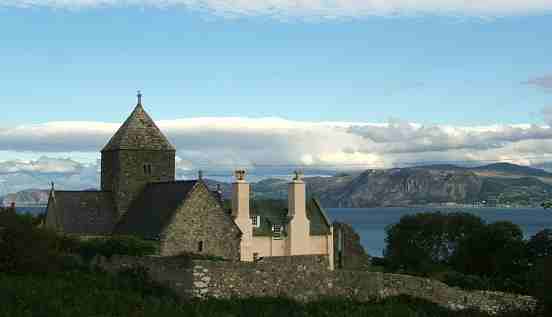
Situated on the eastern tip of Anglesey, Penmon is home to a former Augustinian monastery and an early 17th century dovecote. We took the A55 road from Holyhead, heading east and eager to discover more about this fascinating village on the quiet Anglesey coast, with Puffin Island just a stone's through away. It has links to Viking invaders, ancient Kings of Wales and the early Christian Church.
Click here to tell us your story about this place Just before reaching the Britannia Bridge we took the junction for Menai Bridge and Beaumaris. At this moment we thought about St seiriol, the Celtic saint who founded the monastery at Penmon in the 6th century. Well, he was a good friend of St Cybi, who founded a monastery in the fort of Holyhead, then a sleepy little fishing settlement, in about 540 AD. You see, unlike us, they had no car, no e-mail and no telephone. So instead they arranged to walk across the island,meeting about halfway. As St Seiriol left his monastery heading westward, the morning sun was on his back hence Seiriol Wyn (Pale Seiriol). While St Cybi or Cybi Felyn (Golden Cybi) walked eastward, he had the sun in his face. They met in the middle of the island and did what monks do when they meet, and then set off back home again. So St Seiriol now still had the sun, setting in the west, on his back for his homeward trek.
We know that St Seiriol was buried on the nearby Puffin Island , just off the strong tidal waters of at Trwyn Du (or Puffin Sound) Penmon Priory Church The church at Penmon is dedicated to St Seiriol, founder of the original monastery, and an old 6th century cell in the rock can be found nearby, where a well exists to this day.
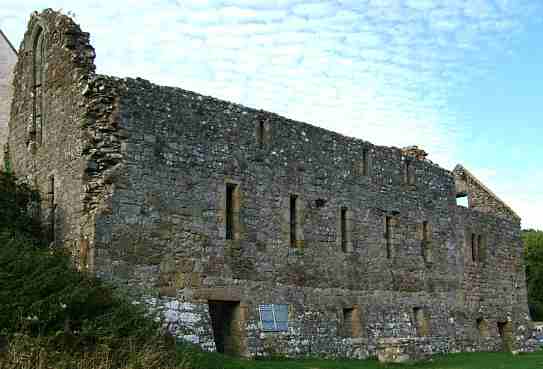
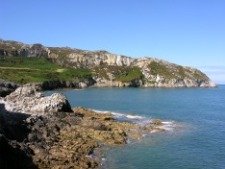
Any visitor to this spot will notice how peaceful it is, and with magnificent coastal and mountain views to enhance the earthy experience. We first entered an imposing stone built building, probably dating back to the 13th century. It is believed that this structure was the Dining Hall used by Augustinian monks.
Below the 1st floor Dining Hall (Refectory) was the cellar below. There is another smaller unit next door which was probably used as a kitchen and added later in the 16th century. While on the subject of food I wasn't aware that Augustinians were not allowed to eat red meat. Theirs was a simple diet which did however include fish. Inside the church we saw how the natural light enhanced the beautiful stained glass east window. Shades of blue and red changed in tone as the light fluctuated in intensity, a passing cloud blotting out the sun momentarily. At the back of the church is a mini-museum where you will find two carved 10th century Celtic crosses originally for outside worship.
And the Penmon cross (from about 1000 AD) which stood about 400 m to the north west of the church, is now also housed in the Nave. You will see that weathering has dissolved the sharp resolution of the figures on the cross.
Dissolution of the Monasteries In 1536 King Henry 8th of England ordered the dissolution of the monasteries throughout England and Wales. As a result Penmon priory and the surrounding land was transferred to the Bulkeley family.
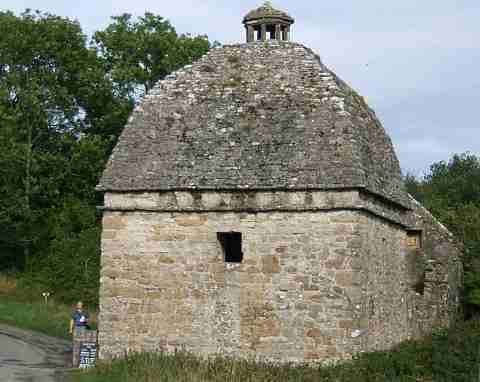
It was the Bulkeley's who were responsible for building the impressive Penmon dovecote next to the priory. Records suggest it was built around 1600 by Sir Richard Bulkeley of Beaumaris. The dovecote is a solid, square stone structure with an enormous domed roof, and at its apex is an open cupola.
When you walk throught the narrow side entrance you'll see a 12 feet high stone pillar. This would have given access to over a thousand nests which line the surrounding walls.
What Other Visitors Have SaidClick below to see contributions from other visitors to this page...
MAGICAL PENMON DAY OUT
Penmon last June
A Wonderful Day at Penmon Priory
Holy Well Healing Powers
Discover St Seiriols Well, Penmon
PENMON PRIORY
Peaceful Penmon Priory Inspires a Deepening Faith Not rated yet
Beautiful Penmon revisited June 2011 Not rated yet
Yacht Sinks off Puffin Island Not rated yet
Penmon Priory Extortionate Car Parking Not rated yet
Penmon Limestone Not rated yet
St Seiriol's Priestholm on Puffin Island Not rated yet
Dovecote At Penmon Not rated yet
The Prior's House, Penmon, Anglesey Not rated yet Return to Historic Coast
|